
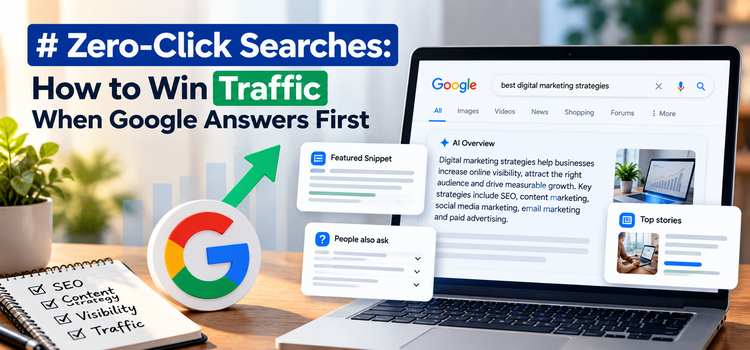
Zero-click searches are Google
searches that end without a click to any website. SparkToro’s analysis of early
2026 US data found that about 68% of Google searches ended this way. Google now
answers questions directly through featured snippets, AI Overviews and local
packs. This guide shows you how to win traffic anyway, using answer engine
optimization (AEO) and generative engine optimization (GEO) to earn citations,
build brand visibility and still drive clicks and leads.
Quick Answer: How Do You Win Traffic From Zero-Click Searches?
You win by becoming the source
that Google and AI tools quote, then giving searchers a reason to click for
more. Lead each section with a direct answer, add schema markup, build brand
authority, target queries that need depth, and offer tools, data and templates
that a summary cannot replace.
Key takeaways:
•
Zero-click searches are growing, mainly because of AI
Overviews and other answer features.
•
AEO gets your content selected as the direct answer.
GEO gets your brand cited in AI-generated answers.
•
Original data, clear structure and strong authority
signals increase your chances of being cited.
•
Track citations, branded searches and conversions, not
only organic sessions.
What Are Zero-Click Searches?
A zero-click search is a query
where the searcher gets what they need on the results page and leaves without
visiting a website. AI chat tools such as ChatGPT, Gemini and Perplexity also
give full answers inside the interface.
Common zero-click formats
include:
•
Featured snippets: a short answer box at the top
of the results.
•
AI Overviews: AI-generated summaries that cite
several sources.
•
People Also Ask (PAA): expandable questions with
short answers.
•
Knowledge panels: brand, person and place
information.
•
Local pack: map listings with ratings, hours and
directions.
•
Instant answers: weather, conversions,
calculators and definitions.
Why Zero-Click Searches Are Rising in 2026
SparkToro, using Similarweb clickstream
data for January to April 2026, reported that 68.01% of US Google searches
ended without a click. That is up from 60.45% in 2024, though comparisons
across years should be treated with caution because the data providers changed.
The same coverage reports that AI Overviews appeared on more than 20% of
searches and cut click-through rates by nearly 60% when present. (Source:
SparkToro study, early 2026)
Three forces drive the trend:
•
AI-generated summaries answer the question
before any link is shown.
•
Richer results pages with snippets, PAA boxes,
maps and videos keep users on Google.
•
AI chat tools give users another way to get
answers without visiting websites.
Are Zero-Click Searches Bad for SEO?
Not entirely. Zero-click results
reduce clicks on some queries, but being quoted in an answer builds brand
visibility and trust.
High risk for traffic loss:
•
Simple definitions and quick facts
•
Weather, time and unit conversions
•
Basic how-to questions with short answers
Safer for traffic:
•
Comparisons and “best” lists
•
In-depth guides and tutorials
•
High-consideration purchases such as software and
services
•
Local and transactional queries where users need to
call, visit or buy
Your strategy should protect
traffic on safer queries and turn high-risk queries into brand exposure.
AEO vs GEO vs SEO: What Is the Difference?
•
SEO (search engine optimization): improves how
your pages rank so users click through to your site.
•
AEO (answer engine optimization): structures
content so search engines select it as the direct answer in featured snippets,
PAA boxes and voice search.
•
GEO (generative engine optimization): increases
the chance that AI systems such as AI Overviews, ChatGPT, Gemini and Perplexity
mention or cite your brand in generated answers.
Good AEO and GEO do not replace
SEO. They extend it to the places where answers are now delivered.
9 Ways to Win Traffic When Google Answers First
1. Lead every section with a direct answer
Put the answer in the first one
or two sentences under each heading, then add detail. Aim for 40 to 60 words
for the direct answer. Search engines and AI tools extract clear,
self-contained answers more easily than long introductions.
•
Use question-style H2 and H3 headings such as “What
is X?” and “How does X work?”
•
State the answer plainly before explaining nuance.
2. Target question-based keywords
Build content around the
questions your audience actually asks.
•
Review Google’s People Also Ask boxes for your main
topics.
•
Check Google Search Console for queries that start with
what, why, how and best.
•
Group related questions into one thorough page instead
of many thin pages.
3. Use extractable formatting
AI systems and snippet
algorithms favor content that is easy to parse.
•
Write short paragraphs of two to four sentences.
•
Use numbered lists for steps and bulleted lists for
options.
•
Include a short key takeaways box near the top.
4. Add structured data
Schema markup helps machines
understand what your page is and who published it. Even where Google limits
rich result display, structured data supports clear entity understanding.
•
Use Article or BlogPosting schema with author and date.
•
Add Organization and Person schema to define your brand
and experts.
•
Add FAQPage schema where you publish genuine
question-and-answer content.
•
Validate markup with Google’s Rich Results Test.
5. Publish original data and expert insight
AI tools cite sources that add
something new.
•
Share first-party data, surveys, benchmarks and case
studies.
•
Include named authors with credentials and real
experience.
•
Update key pages when facts change.
6. Build brand mentions and entity authority
Generative engines learn which
brands are trusted for a topic from mentions across the web, not only from your
website.
•
Keep your brand name and profile details consistent on
LinkedIn, directories and social platforms.
•
Earn mentions and links through digital PR, expert
quotes and industry features.
•
Collect genuine customer reviews on Google and relevant
platforms.
7. Keep your site technically ready and fresh
Content can only be cited if it
can be crawled and understood.
•
Make sure Googlebot can crawl and index your key pages.
•
Review your robots.txt rules for AI crawlers and decide
deliberately which to allow.
•
Improve Core Web Vitals and show a clear last-updated
date.
8. Give searchers a reason to click
A summary can give the answer,
but it cannot give the experience. Offer depth after the answer.
•
Build calculators, checkers and interactive tools.
•
Provide downloadable templates and checklists.
•
Publish detailed case studies and step-by-step
walkthroughs.
9. Optimize beyond your website
Searchers and AI tools pull from
many platforms, so your presence should not depend on one page.
•
Optimize your Google Business Profile with categories,
services and photos.
•
Publish helpful videos on YouTube with clear titles and
chapters.
•
Share expert posts on LinkedIn and list your business
in trusted directories.
How to Measure Success Beyond Clicks
If you only track organic
sessions, zero-click results will look like a decline. Add these measures:
•
Impressions and click-through rate in Google
Search Console, tracked by query group.
•
Branded search growth, which shows rising
awareness.
•
AI citation checks: every month, ask ChatGPT,
Gemini and Perplexity your target questions and record whether your brand is
mentioned or linked.
•
AI referral traffic in Google Analytics 4,
filtered by source.
•
Conversions and assisted conversions, since
visitors who do click are often further along in the buying process.
Common Mistakes to Avoid
•
Writing long introductions that bury the answer.
•
Copying competitor summaries without adding new
information.
•
Marking up content with schema that does not appear on
the page.
•
Ignoring brand mentions and reviews outside your site.
•
Measuring success only by clicks.
Frequently Asked Questions
What are zero-click searches?
Zero-click searches are queries
where the user gets an answer on the results page and does not click any
website. They include featured snippets, AI Overviews, knowledge panels, local
packs and instant answers such as weather and calculators.
Are zero-click searches bad for SEO?
They reduce clicks on simple,
factual queries, but they increase brand exposure when your content is quoted.
Comparison, research and transactional queries still send traffic. Measure
impressions, citations and conversions as well as clicks.
What is the difference between AEO and GEO?
AEO (answer engine optimization)
structures content so search engines select it as a direct answer, such as a
featured snippet. GEO (generative engine optimization) increases the chance
that AI tools like ChatGPT, Gemini and Perplexity cite or mention your brand in
generated responses.
How do I get my content into featured snippets and AI Overviews?
Answer a specific question in
the first 40 to 60 words, use clear headings and lists, add schema markup, and
support the answer with original data and expert authorship.
How can I track visibility in AI search?
Ask your target questions in
ChatGPT, Gemini and Perplexity each month and record mentions and links. Also
monitor branded search volume, AI referral sources in Google Analytics 4, and
impressions in Google Search Console.
Conclusion
Zero-click searches are not the
end of organic traffic. They change where and how you earn attention. Answer
questions directly, structure your content for extraction, back it with
original expertise and brand authority, and give searchers tools and depth that
justify a click. Start by updating your top ten pages with direct answers,
schema markup and a clear next step.
Want your brand cited in Google AI Overviews and AI search results? The SEO team at Solomo Media builds AEO and GEO strategies for businesses across India and globally. Contact us for a free AI search visibility review.
