
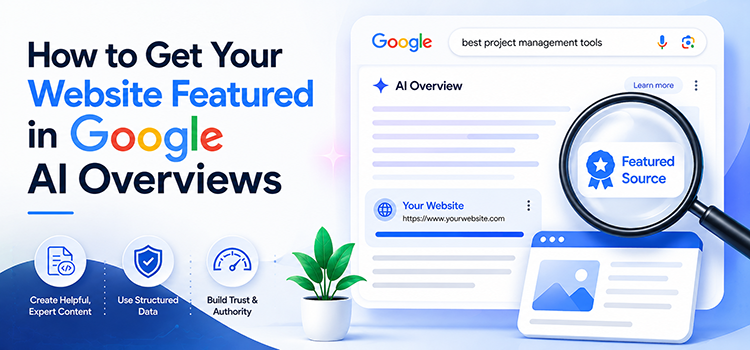
Google search doesn’t look the way it used to. If you’ve typed a question into Google recently, you’ve likely seen a large, AI-generated summary sitting right at the top of the page — above every organic result, every paid ad, and every featured snippet. That’s the Google AI Overview, and for businesses that rely on organic traffic, it’s changing everything.
Here’s the hard truth: a growing share of users read that AI summary and never scroll down. They got their answer. They’re gone. Your site never got a visit — even if you rank on page one.
But here’s the opportunity hidden inside that problem. Google has to pull that AI answer from somewhere. With the right strategy, your content can be the source it pulls from. This guide breaks down exactly how to make that happen.
Why Your Organic Traffic Has Dropped (And What’s Behind It)
Traffic drops across the web aren’t a mystery anymore. When users get a direct, well-structured answer at the top of the search results page, the need to click through disappears. This “zero-click” behaviour is accelerating, and it’s affecting businesses across nearly every industry.
The shift isn’t just about how Google displays results — it’s about how people search. Queries have gotten longer, more specific, and more conversational. Someone isn’t just searching “running shoes” anymore. They’re asking, “What are the best running shoes for someone with flat feet who runs 20km a week?” These longer, intent-rich searches are exactly what AI Overviews are built to handle.
To stay visible, your content strategy needs to catch up.
1. Write for Questions, Not Just Keywords
Traditional SEO focused on matching keywords. AI-driven search focuses on matching intent — specifically, answering the exact question a user is asking as clearly and completely as possible.
Every piece of content you publish should open with a direct, concise answer in the first two to three sentences. Think of it as the “bottom line up front” approach. If someone asks a question your page covers, the AI should be able to extract a clean, complete answer from your opening paragraph.
From there, go deeper. Anticipate the follow-up questions a reader would naturally have and answer those too. Content that covers a topic end-to-end — not just one narrow angle — gives AI models more to work with and positions you as the most complete source available.
2. Build Genuine Authority Through EEAT
Google’s content quality framework — Experience, Expertise, Authoritativeness, and Trustworthiness (EEAT) — has never mattered more. It’s essentially Google’s way of filtering out generic, low-effort content that anyone (or any AI) could generate.
What makes EEAT content stand out?
- First-hand experience: Don’t just explain what something is — share how you’ve used it, what results you saw, and what you’d do differently. That layer of lived experience is something a language model can’t fabricate.
- Original data and case studies: Real numbers from your own work carry far more weight than recycled statistics. If you ran a campaign, tested a product, or tracked a trend internally — write about it.
- Named authors with credentials: Content attributed to a real, qualified person with a bio and professional history signals trustworthiness to both Google and its AI systems.
Generic content is invisible in AI search. Specific, experienced-backed content gets cited.
3. Use Multiple Content Formats on a Single Page
AI systems are increasingly evaluating how useful a page will be for the reader — not just whether it contains the right text. Pages that pair written content with images, infographics, and short videos consistently perform better in AI Overview selection.
Why? Because they signal that the content is accessible to a wider range of users. If your page teaches a process, a step-by-step video paired with written instructions makes it the most complete version of that answer available.
Short-form videos (under 90 seconds) with accurate transcripts are especially effective. When AI summarises a how-to topic, it favours pages that provide both visual and written walkthroughs — and your content is more likely to appear as the cited source.
4. Make Sure Google Can Actually Read Your Site
Outstanding content means nothing if search crawlers can’t access it. A few technical fundamentals that directly affect AI visibility:
- Clean site architecture: Internal links should connect related pages logically. Orphan pages — those with no links pointing to them — are effectively invisible to AI crawlers.
- HTML-first content delivery: Insights buried inside JavaScript components, accordions, or “Read More” toggles may never be indexed. If it isn’t in the page’s HTML on initial load, assume the AI won’t see it.
- Proper heading structure: Use H1, H2, and H3 tags consistently to create a clear hierarchy. This helps AI understand which sections of your page cover which topics — making it far easier to extract and cite specific sections.
5. Add Structured Data to Your Pages
Structured data (typically written in JSON-LD format) is the code layer beneath your visible content that tells search engines exactly what your page is about. It helps Google categorise your content accurately within its broader knowledge systems — and being properly categorised is a prerequisite for showing up in AI Overviews.
The most impactful schema types to implement:
- Article — for blog posts and editorial content
- FAQ — for question-and-answer sections (these frequently appear in AI-generated results)
- Person — for author bios and expert attribution
Once implemented, validate your markup using Google’s Rich Results Test to catch any errors that could prevent your structured data from being read correctly.
6. Track the Right Metrics Going Forward
Clicks and click-through rates are becoming less reliable as measures of success in AI-first search. If your content appears in an AI Overview, thousands of people might read your brand name and your answer without ever visiting your site. That still has enormous value — but traditional analytics won’t capture it.
Shift your measurement focus toward:
- Impressions in Google Search Console — Are you appearing for more queries?
- AI citations and SERP feature tracking — Tools like Semrush and Ahrefs now track when your content is referenced in AI results.
- Brand search volume — An indirect signal that your visibility in AI is building recognition.
The Bottom Line
Ranking in Google AI Overviews isn’t about gaming a new algorithm. It’s about being genuinely the best answer available — structured clearly, backed by real expertise, technically accessible, and presented in a format that serves every type of reader.
The businesses that adapt now will build a visibility advantage that’s hard to close. Those that keep optimising for a version of search that no longer exists will keep wondering why their traffic isn’t recovering.
Start with one piece of content. Apply these principles. Measure what changes. Then scale what works.
Need help building an AI-ready content strategy for your website? Get in touch. We’d love to help.
