
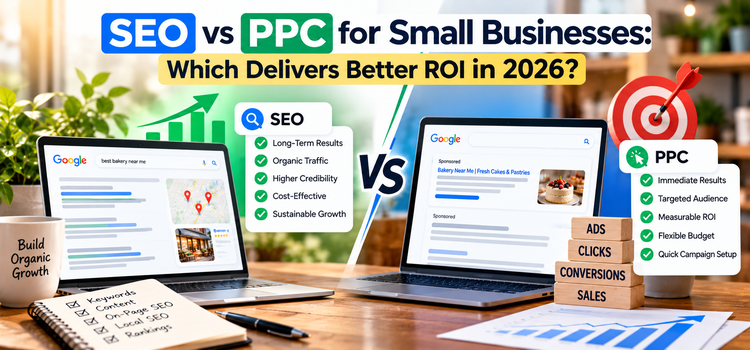
Marketing budgets are tight, and every dollar has to prove itself. So when a small business owner asks whether to invest in SEO or PPC, the real question is simple: which one brings back more money than it costs? SEO usually delivers the better long-term ROI, while PPC delivers faster results. SEO builds visibility you own. PPC rents visibility you pay for. The right choice depends on your budget, timeline, and industry, and for most small businesses the winning answer is to use both in the right order. This guide breaks down cost, speed, ROI math, and a practical plan so you can decide with confidence.
Key Takeaways: SEO vs PPC at a Glance
• SEO builds a lasting asset. Traffic compounds, and your cost per lead tends to fall over time.
• PPC buys instant visibility. Leads start within days but stop the moment your budget does.
• Best ROI usually comes from launching PPC for quick leads while building SEO underneath.
• Local businesses often get the strongest return from local SEO and an optimized Google Business Profile.
• Expensive-click industries such as legal, insurance, and home services benefit most from investing in SEO.
• AI search rewards clear, trustworthy, well-structured content, an advantage ads cannot buy.
How SEO and PPC Work for Small Business Marketing
How SEO Works
Search engine optimization (SEO) is the process of improving your website, content, local listings, and reputation so search engines rank you higher in organic results. When someone searches “emergency plumber near me” or “best bookkeeping software for freelancers,” an organic ranking puts you in front of them without paying per click. Effective SEO usually covers four areas:
• On-page SEO: page titles, headings, and content that match what searchers actually want.
• Technical SEO: site speed, mobile usability, clean structure, and structured data.
• Local SEO: your Google Business Profile, local citations, and customer reviews.
• Off-page SEO: backlinks, brand mentions, and other signals of authority.
How PPC Works
Pay-per-click (PPC) advertising places your ad at the top of search results or on other platforms, and you pay each time someone clicks. Most small businesses run PPC through Google Ads, where you bid on keywords and compete in an auction. Your results depend on three things: your bid, your ad relevance, and the quality of the landing page. Google rewards relevant ads and pages with better positions and lower costs, which is why campaign quality matters as much as budget.
SEO vs PPC: Head-to-Head Comparison
Here is how the two channels compare on the factors that matter most to a small business.
Cost Structure
SEO costs time, content, and expertise rather than per-click fees. PPC charges for every click, whether that visitor buys or bounces. In competitive markets, a single click can cost many times more than in a low-competition niche.
Speed to Results
PPC wins on speed. A properly built campaign can send visitors within days. SEO typically takes a few months to gain real traction, and competitive keywords can take longer.
Longevity
A page that ranks can keep bringing visitors for years. An ad stops working the second you pause it. This single difference is the main reason SEO tends to win on long-term ROI.
Trust and Click Behavior
Many searchers scroll past ads and click organic results because they feel more credible. Appearing in both places reinforces your brand, but organic rankings often carry the stronger trust signal.
Control and Targeting
PPC gives you precise, instant control over budget, location, schedule, and messaging. SEO offers less direct control, because rankings depend on how search engines evaluate your site and competitors.
Scalability
PPC scales as fast as your budget allows, though costs rise as you push into more competitive traffic. SEO scales through consistent publishing, authority building, and continuous improvement.
Risk and Predictability
PPC can drain budget quickly when targeting is loose or the landing page fails to convert. SEO can stall if you ignore fundamentals, and search engines update their systems regularly. Neither is risk free, but both become far more predictable once you track your numbers.
SEO vs PPC ROI: How to Calculate Which Pays Off
ROI is simple to calculate: (Revenue minus Cost) divided by Cost. Here is a quick illustration using made-up numbers:
• You spend $1,000 on ads and get 20 leads, so your cost per lead is $50.
• Five of those leads become customers worth $400 each, which is $2,000 in revenue.
• Your ROI is 100 percent: you earned back your spend plus an equal profit.
To compare channels fairly, track these metrics for each one:
• Cost per lead (CPL): total spend divided by leads generated.
• Customer acquisition cost (CAC): total spend divided by new customers won.
• Conversion rate: the percentage of visitors who call, book, or buy.
• Customer lifetime value (CLV): the total revenue a customer brings over time.
• Return on ad spend (ROAS): revenue generated per dollar of ad spend, used for PPC.
• Organic traffic and leads: the visits and inquiries that come from search rankings, used for SEO.
Timing matters too. Compare both channels over twelve months rather than three, because SEO costs are front-loaded while its returns keep building.
Why SEO Usually Delivers Better Long-Term ROI
• It compounds. Every optimized page, review, and backlink adds to a foundation that keeps working.
• Cost per lead falls over time. You are not paying for each additional visitor.
• It builds authority. Ranking organically signals credibility to potential customers.
• You own the asset. Your content and rankings belong to your business, not an ad platform.
• It lifts every other channel. A faster, clearer website improves conversions from ads, email, and social too.
When PPC Delivers Better ROI
• You need leads now, such as for a launch, sale, or seasonal rush.
• You are testing an offer or market before committing long term.
• Your margins are high, so expensive clicks still produce a profit.
• Your website is brand new and has little authority to rank yet.
Bonus: PPC doubles as keyword research. The search terms that convert in your ads show you exactly which keywords to target with SEO.
SEO vs PPC by Business Type
• Local service business (plumber, dentist, salon): start with local SEO and Google Business Profile, then add PPC for urgent demand.
• E-commerce store: use PPC to move products now and SEO to build category and product page rankings.
• New startup: begin with PPC to learn what converts, then invest in SEO as budget allows.
• High-ticket or B2B service: combine both, since research-heavy buyers respond to helpful content and targeted ads.
• Seasonal business: lean on PPC during peak weeks and keep SEO running all year.
Local SEO vs PPC for Local Businesses
If customers find you through “near me” searches, local SEO deserves priority. Showing up in the Google Maps results and local pack puts your phone number, reviews, and directions in front of people ready to act. A well-optimized Google Business Profile, consistent business details, and a steady flow of genuine reviews often deliver leads at a lower cost than ads. PPC then fills the gaps, such as boosting visibility during busy seasons or promoting a new service.
How AI Search Changes SEO vs PPC (AEO and GEO)
Search results now include AI-generated summaries and answer boxes. These features tend to draw from content that is clear, accurate, and well structured. Ads can appear nearby, but the answer itself comes from sources the system trusts. To get cited through answer engine optimization (AEO) and generative engine optimization (GEO):
• Answer questions directly with short, clear explanations near the top of each page.
• Keep your business details consistent across your website, listings, and social profiles.
• Add structured data such as LocalBusiness and FAQ schema.
• Publish original, expert content that shows real experience and results.
This is a growing advantage for SEO, because you cannot simply pay to be the source of an AI-generated answer.
What Affects the Cost of SEO and PPC
Prices vary widely, so instead of chasing a single number, understand what drives the cost of each channel.
• PPC cost drivers: industry competition, keyword demand, ad quality, landing page relevance, and location targeting.
• SEO cost drivers: keyword competitiveness, the current state of your website, how much content you need, and whether you work in-house or hire help.
A useful rule: the more expensive clicks are in your industry, the more attractive SEO becomes, because every organic visitor saves you that fee.
How to Get Faster Results From SEO
• Target local and long-tail keywords. Phrases like “emergency plumber in Austin” are easier to rank for than broad terms.
• Fix technical basics first. Page speed, mobile usability, and clean site structure remove ranking obstacles.
• Update pages that already rank. Refreshing existing content is often quicker than starting from scratch.
• Earn reviews and local mentions. These trust signals help you stand out in local results.
• Match search intent. Give people exactly the answer, price guide, or service page they expect.
How to Lower Your PPC Costs
• Add negative keywords to stop paying for irrelevant clicks.
• Improve ad relevance and landing pages to raise your Quality Score and reduce cost per click.
• Narrow your targeting by location, device, and time of day.
• Track conversions properly so you can cut campaigns that do not produce leads.
• Send each ad to a matching page rather than your homepage.
5 SEO and PPC Mistakes That Waste Your Budget
• Expecting instant SEO results. Judge progress over months, not weeks.
• Running ads without conversion tracking. Clicks are not customers.
• Sending traffic to a weak website. Slow, confusing pages kill conversions from any source.
• Targeting keywords that are too broad. Specific, local, high-intent terms convert better.
• Setting it and forgetting it. Both channels need regular review and adjustment.
90-Day Plan to Combine SEO and PPC
Days 1 to 30: Build the Base
• Fix your website speed, mobile layout, and contact options.
• Claim and optimize your Google Business Profile.
• Launch a small PPC campaign on your highest-intent keywords.
Days 31 to 60: Create and Learn
• Publish service pages and blog posts that answer buyer questions.
• Review which ad keywords convert and note them for SEO.
• Start collecting customer reviews consistently.
Days 61 to 90: Optimize and Shift
• Cut underperforming ads and increase budget on winners.
• Expand content around your best-performing topics.
• Compare cost per lead from both channels and rebalance.
If you would rather have experts guide this process, the team at Solomo Media can help you build a website and search strategy that balances quick wins with lasting growth.
SEO vs PPC: Frequently Asked Questions
Is SEO better than PPC for small businesses?
For long-term ROI, usually yes. SEO tends to lower your cost per lead over time because results compound. PPC is better when you need customers immediately.
How long does SEO take to work?
Many businesses see movement within three to six months, depending on competition, website quality, and consistency.
How much should a small business spend on PPC?
There is no fixed number. Start with an amount you can afford to test for several weeks, set clear goals, and increase spending only on campaigns that return more than they cost.
Can I use SEO and PPC together?
Yes, and most small businesses should. PPC delivers quick leads and keyword data while SEO builds lasting visibility.
Does PPC improve SEO rankings?
Not directly. Ads do not boost organic rankings, but their data can guide your SEO strategy.
Which is better for a local business?
Local SEO with an optimized Google Business Profile is often the most cost-effective start. Add PPC for urgent or seasonal demand.
How do I know which channel gives better ROI?
Track cost per lead, conversion rate, and revenue from each source. Compare them over the same period and include customer lifetime value.
Is SEO still worth it with AI search?
Yes. AI-generated answers draw from clear, trustworthy, well-structured content, which is exactly what good SEO produces.
Final Verdict: SEO or PPC for Your Small Business?
SEO gives most small businesses the better ROI over time, while PPC gives the faster start. If you can be patient and want durable results, invest in SEO. If you need customers now, use PPC to bridge the gap. For most, the winning move is a blend that shifts toward SEO as your rankings grow.
Ready to get more customers for every dollar you spend? Visit Solomo Media and let the team build the right SEO and PPC mix for your business.
