
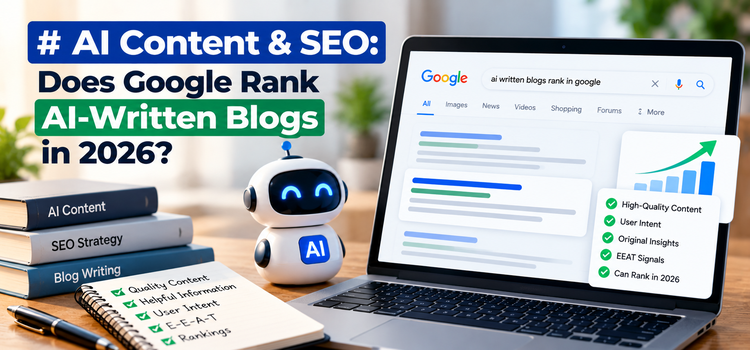
Yes, Google ranks AI-written
blogs when the content is helpful, accurate and original. Google does not
penalize content because AI produced it. It acts against low-quality pages
created at scale to manipulate rankings. In Ahrefs’ study of 600,000 pages,
86.5% of top-ranking pages contained some AI-generated content. This guide
explains what Google’s policies say, what the data shows and how to publish AI
content that ranks.
Quick Answer: Does AI Content Rank on Google?
AI content can rank on page one
if it satisfies search intent, adds original value and is reviewed by a human.
It fails when it is generic, inaccurate or mass-produced. The deciding factor
is quality, not the tool used to write it.
Key takeaways:
•
Google allows AI-generated content that is helpful and
meets its quality standards.
•
Publishing AI content at scale without adding value
violates Google’s spam policies.
•
Most top-ranking pages already use some AI assistance.
•
Human editing, original insight and fact-checking separate
ranking pages from ignored ones.
•
Disclose and review AI-generated titles, meta
descriptions and structured data.
What Does Google Say About AI-Generated Content?
Google’s Search Central guidance
states that AI-generated content is acceptable when it provides real value to
users. The company’s concern is how content is used, not which tool created it.
The key points from the
guidance:
•
AI use is not banned. Content that is useful and
trustworthy can rank, whether a person, an AI tool or both produced it.
•
Scaled content abuse is spam. Generating many
pages mainly to manipulate rankings, with little effort, originality or added
value, breaks Google’s spam policy.
•
Accuracy matters. AI models predict likely words
and can produce errors, so manual fact-checking is essential before publishing.
•
Review everything generated. Titles, meta
descriptions, structured data and alt text should all be checked.
•
Context helps readers. Google suggests telling
users how content was created where it adds helpful context.
(Source: Google Search Central
guidance on generative AI content)
Does Google Penalize AI Content?
Google does not penalize content
only because it was written with AI. It penalizes or demotes content that is
unhelpful, deceptive or created mainly for search engines. AI makes it easy to
produce that kind of content quickly, which is why AI sites are often hit.
Content most at risk includes:
•
Hundreds of near-identical pages built from templates
with only the keyword changed.
•
Rewritten competitor articles that add no new
information.
•
Pages with unchecked facts, invented statistics or fake
citations.
•
Thin articles that repeat the same points without
answering the question.
•
Content that targets keywords with no real expertise or
experience behind it.
If a human writing the same page
would be demoted for these reasons, an AI-written page will be demoted too.
What the Data Shows About AI Content and Rankings
Ahrefs analyzed 600,000 web
pages across 100,000 keywords using its AI content detector. The results:
•
86.5% of top-ranking pages contained some
AI-generated material.
•
81.9% blended human and AI writing.
•
4.6% were entirely AI-generated.
•
13.5% were purely human-written.
•
The correlation between AI usage and ranking position
was close to zero.
The same study noted that the
highest-ranking pages leaned slightly toward human-written content or content
with minimal AI help. The takeaway is clear: AI is widely used by pages that
rank, and human oversight still helps. (Source: Ahrefs AI content study)
AI Content vs Human Content: Where Each Wins
Use each where it is strongest.
AI is strong at:
•
Researching topics and building outlines quickly.
•
Drafting first versions and summarizing sources.
•
Generating title, meta description and FAQ options.
•
Rewriting for clarity and consistent structure.
Humans are needed for:
•
First-hand experience, opinions and real examples.
•
Original data, interviews and case studies.
•
Fact-checking and verifying sources.
•
Brand voice, nuance and final editorial judgment.
The best approach is
AI-assisted, human-led content: AI speeds up the process, and people provide
the expertise and accountability.
8 Steps to Make AI-Written Blogs Rank
1. Start with search intent, not a prompt
Check what already ranks for
your keyword and what format and depth searchers expect. Then write a prompt
around that intent, with your audience, angle and required sections.
•
Review the top 5 results and note the questions they
answer.
•
Identify gaps that your page can fill.
2. Add original insight AI cannot invent
Add what only your business
knows.
•
Include first-party data, client results and
screenshots.
•
Add expert quotes, opinions and real examples.
•
Share processes and lessons from actual projects.
3. Fact-check every claim
AI tools can invent statistics,
sources and quotes.
•
Verify every number against the original source.
•
Link to primary sources such as official documentation
and studies.
•
Remove any claim you cannot confirm.
4. Edit for clarity and brand voice
Raw AI drafts often sound
generic and repetitive.
•
Cut filler, repeated phrases and vague openers.
•
Use short paragraphs, specific examples and direct
answers.
•
Match your brand’s tone and terminology.
5. Show real authorship and E-E-A-T
Demonstrate experience,
expertise, authoritativeness and trust.
•
Add a named author with a bio and credentials.
•
Include a reviewed-by line for sensitive topics.
•
Show a publish date and a last-updated date.
6. Optimize on-page SEO properly
•
Put the primary keyword in the H1, first 100 words,
meta title and URL.
•
Use question-based H2s and add a FAQ section with
concise answers.
•
Add internal links to related pages and schema markup
such as Article and FAQPage.
•
Write unique meta descriptions and descriptive image
alt text.
7. Avoid scaled, low-value publishing
Quality beats quantity.
•
Publish fewer pages that are each genuinely useful.
•
Do not mass-produce location or keyword variations
without unique value.
•
Consolidate thin pages into one stronger resource.
8. Update and measure performance
•
Track impressions, clicks, average position and
conversions in Google Search Console and Google Analytics 4.
•
Refresh top pages every six months with new data and
examples.
•
Improve or remove pages that never gain traction.
AI Content Risks to Avoid
•
Hallucinated facts: invented studies, dates and
quotes damage trust.
•
Duplicate or near-duplicate content: many
writers using similar prompts produce similar articles.
•
Generic tone: content that could belong to any
brand rarely earns links or citations.
•
Unreviewed metadata: AI-generated titles,
descriptions and schema should be checked before publishing.
•
Copyright issues: do not publish text that
closely copies existing sources.
Frequently Asked Questions
Does Google penalize AI-generated content?
No, not for being AI-generated.
Google acts against content created mainly to manipulate rankings, including
scaled pages with little originality or value. AI content that is helpful,
accurate and well edited can rank like any other content.
Can AI-written blogs rank on page one?
Yes. Ahrefs found that 86.5% of
top-ranking pages in its 600,000-page study contained some AI-generated
content. Pages rank when they match search intent, add value and show
credibility, whether a person or AI wrote the first draft.
Does Google detect AI content?
Google’s guidance focuses on
content quality and spam behavior, not the writing tool. Do not try to
“bypass detection.” Improve accuracy, originality and usefulness
instead, because those are the signals that determine whether a page performs.
Should I tell readers my blog uses AI?
Google suggests giving readers
context about how content was created where it is helpful. If AI helped draft
the article and an expert reviewed it, a short note or a reviewed-by line
builds transparency and trust.
What is the best way to use AI for blog writing?
Use AI for research, outlines
and first drafts, then add original insight, verify facts, edit for brand voice
and add author credentials. Humans should own the final accuracy, examples and
recommendations before the page is published.
Does AI content hurt E-E-A-T?
Not automatically. E-E-A-T
depends on whether the content shows real experience, expertise and trust. Add
named authors, first-hand examples, verified sources and updated dates so the
page demonstrates credibility, whatever tools helped write it.
Conclusion
AI content can rank in 2026, but
only when it is helpful, accurate and original. Use AI to move faster, then
rely on people for expertise, fact-checking and editing. Start by auditing your
existing AI-written posts for thin sections, unverified claims and missing
author details.
Want a content strategy that
ranks in Google and gets cited in AI search? The SEO and content team at Solomo
Media creates expert-led, search-optimized blogs for businesses across India
and globally. Contact us for
a free content audit.
