
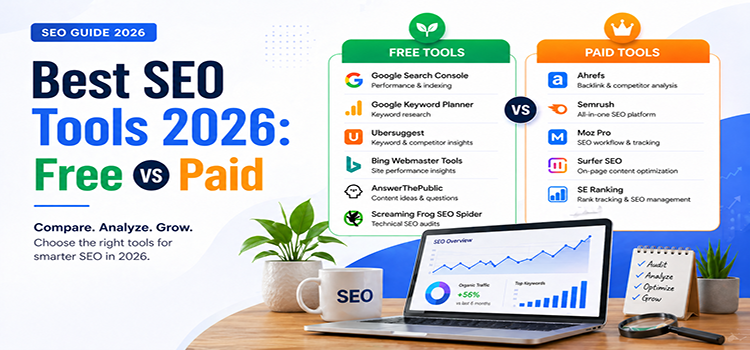
Search engine optimization in 2026 is more structured and competitive than ever. With continuous algorithm updates and evolving search behavior, relying on assumptions is no longer effective. Growth now depends on how well you understand data, refine your strategy, and execute consistently.
This is where SEO tools play a critical role.
Whether you are managing a website, running an agency, or working on content strategy, using the right SEO tools in 2026 helps you improve rankings, analyze competitors, and scale organic traffic more efficiently.
However, the real challenge is not access to tools, but clarity. Many marketers use multiple platforms without a defined workflow, which often leads to scattered insights instead of measurable growth.
What Makes a Good SEO Tool in 2026
A good SEO tool is not defined by how much data it shows, but by how useful that data is.
The most effective tools help you:
- Understand keyword research and search intent
- Identify content gaps and ranking opportunities
- Analyze competitors with clarity
- Improve technical SEO performance
- Track keyword rankings and organic traffic
Tools that simplify decision-making tend to deliver better long-term results than those that only present complex dashboards.
Best Free SEO Tools in 2026
Free tools remain the foundation of any SEO strategy. They provide reliable insights and are often enough to build a strong base.
Google Search Console
Best for: Search performance tracking and indexing
Google Search Console provides direct insight into how your website performs in search results. It shows impressions, clicks, keyword visibility, and indexing status.
It is essential for identifying which pages are already ranking and which need improvement. It also highlights technical issues such as crawl errors and indexing problems.
Key capabilities:
✦ Performance tracking across queries and pages
✦ Indexing and crawl issue detection
✦ Page-level SEO insights
✦ Visibility into search trends
Google Keyword Planner
Best for: Keyword research and search demand
Keyword Planner helps identify keyword ideas, search volume trends, and competition levels. It is widely used for SEO keyword research and content planning.
It works best as a starting point to validate keyword demand before creating content.
Key capabilities:
✦ Keyword discovery and search volume insights
✦ Competition-level analysis
✦ Topic validation for SEO content
✦ Seasonal keyword trends
Ubersuggest
Best for: Beginner SEO analysis and competitor research
Ubersuggest combines keyword research, site audits, and competitor analysis in a simplified interface. It helps identify top-performing pages and content ideas in your niche.
Key capabilities:
✦ Keyword suggestions with difficulty scores
✦ Competitor traffic and ranking insights
✦ Basic SEO audit reports
✦ Content idea generation
AnswerThePublic
Best for: Content ideation and search intent analysis
AnswerThePublic focuses on how users phrase their queries. It provides question-based keyword insights, making it useful for long-tail keywords and content strategy.
Key capabilities:
✦ Question-based keyword discovery
✦ Search intent visualization
✦ Content topic ideas
✦ Keyword clustering insights
Screaming Frog SEO Spider
Best for: Technical SEO audits
Screaming Frog crawls your website and identifies issues that affect performance, such as broken links, duplicate content, and missing metadata.
It is essential for maintaining technical SEO health and site structure.
Key capabilities:
✦ Website crawling and structure analysis
✦ Technical issue detection
✦ Duplicate content identification
✦ Internal linking insights
Best Paid SEO Tools in 2026
Paid tools provide deeper insights and advanced features that help scale SEO efforts more effectively.
Ahrefs — Best for Backlink Analysis & Competitor Research
Ahrefs is one of the most widely used tools for backlink analysis and competitor SEO research. It allows you to understand how competitors generate traffic and build authority.
Key capabilities:
✦ Content Gap Analysis to find missing keyword opportunities
✦ Site Explorer for competitor traffic and backlink insights
✦ Keyword Explorer for difficulty and ranking potential
✦ Rank tracking for monitoring keyword positions
Ideal for: Agencies, SEO professionals, and businesses scaling organic growth
SEMrush — Best All-in-One SEO Platform
SEMrush offers a complete suite for managing SEO, content marketing, and competitor analysis. It is widely used for keyword tracking, site audits, and content optimization.
Key capabilities:
✦ Advanced keyword research and filtering
✦ Content optimization tools
✦ Technical SEO audits
✦ Local SEO features
Ideal for: Marketing teams and agencies managing multiple projects
Moz Pro — Best for Structured SEO Workflow
Moz Pro simplifies SEO processes by providing clear recommendations and easy-to-understand metrics. Its Domain Authority metric is widely used to measure site strength.
Key capabilities:
✦ Keyword tracking and analysis
✦ Site crawl and technical SEO insights
✦ Page optimization recommendations
✦ SERP feature tracking
Ideal for: Businesses building a structured SEO strategy
Surfer SEO — Best for Content Optimization
Surfer SEO focuses on improving content performance by analyzing top-ranking pages. It provides recommendations for on-page SEO and content structure.
Key capabilities:
✦ Real-time content editor
✦ SERP-based content analysis
✦ Keyword and structure recommendations
✦ Content scoring system
Ideal for: Content creators and SEO-focused writers
SE Ranking — Best for Balanced SEO Management
SE Ranking combines rank tracking, audits, keyword research, and competitor analysis in a clean interface. It helps maintain consistency in SEO performance.
Key capabilities:
✦ Keyword rank tracking
✦ Website audit reports
✦ Backlink monitoring
✦ Performance reporting
Ideal for: Freelancers, agencies, and growing teams
Free vs Paid SEO Tools: Which Should You Choose
The right choice depends on your goals and stage.
Free tools are ideal for building a foundation. They help you understand performance, conduct basic keyword research, and fix technical issues.
Paid tools become important when you need deeper insights, competitor analysis, and scalable SEO strategies.
In most cases, a combination of both provides the best results.
How to Build a Practical SEO Tool Stack
Instead of using too many tools, focus on building a simple and effective setup:
- One tool for SEO performance tracking
- One for keyword research
- One for technical SEO audits
- One for content optimization
This approach keeps your workflow efficient and avoids unnecessary complexity.
Final Thoughts
The effectiveness of any SEO tool depends on how consistently it is used. Starting with a strong foundation like Google Search Console allows you to understand real performance before making improvements. As your strategy becomes more structured, adding advanced tools for competitor analysis and content optimization becomes more relevant.
A focused approach always works better than a complex setup. Begin with essential tools, refine your workflow, and expand only when needed. As your traffic grows, your toolset should evolve in a way that supports your strategy rather than complicates it.
